The Tundra
The word tundra derives from the Finnish word for barren or
treeless land. The tundra is the simplest biome in terms of species
composition and food chains.
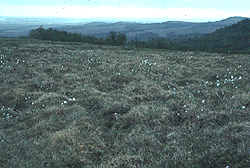
Vegetation: lichens, mosses, dwarfed shrubs, (often heaths, but also birches and willows).
Growthforms: typical are ground-hugging and other warmth-preserving forms including:
- tussock-forming graminoids
- mats or cushion plants, often evergreen members of the heath family
- rosettes
- dwarf shrubs, some of which are deciduous in habit
Climate: The high latitude conditions that impact life in this biome include
- extremely short growing season (6 to 10 weeks)
- long, cold, dark winters (6 to 10 months with mean monthly temperatures below 32° F or 0° C.)
- low
precipitation (less than five inches/year) coupled with strong, drying
winds. Snowfall is actually advantageous to plant and animal life as it
provides an insulating layer on the ground surface.
Why there are no trees: Permafrost, not cold temperatures,
is generally believed to be what prevents tree growth. Furthermore,
freeze-thaw activity, a thin active layer of soil are among the reasons that you don't find many trees in the tundra.
Soil: No true soil is developed in this biome due to the factors mentioned above.
Animals Strategies evolved to withstand the harsh conditions of
the tundra can be divided among those species that are resident and
those that are migratory.
- Among the small number of bird (e.g., ptarmigan) and
mammal (e.g., muskox, arctic hare, arctic fox, musk ox) species that
reside year-round on the tundra one commonly finds:
Body Shape adaptations
- large, compact bodies
- a thick insulating cover of feathers or fur
- hair and plumage that turns white in winter, brown in summer
Physiological adaptations
- ability
to accumulate thick deposits of fat during the short growing season.
Fat acts as insulation and as a store of energy for use during the
winter, when animal species remain active.
Population adaptations
- fluctuations in population size which occur in cycles, best seen perhaps in the
lemming, a small rodent which is the major herbivore in the tundra's
simple food chain. Predator populations and plant populations respond
in kind to the peaks and crashes of the herbivore populations.
- Migratory species such as waterfowl,
shorebirds and caribou adapt to the tundra by avoiding the most severe
conditions of winter. Each year at the end of the short growing season
they move southward into the boreal forest or beyond, but return to the
tundra to breed.
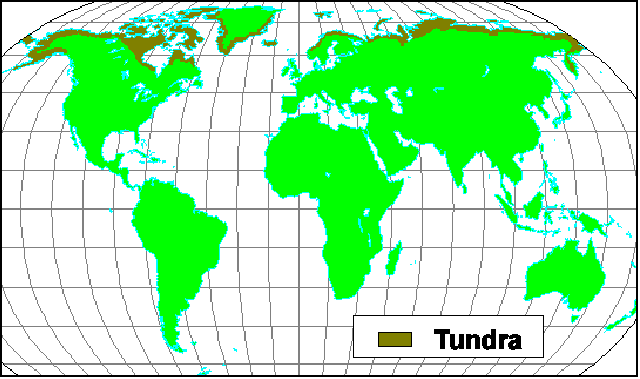
The tundra biome is restricted to the high
latitudes of the northern hemisphere in a belt around the Arctic Ocean.
Many of its species, both plant and animal, have circumpolar
distribution areas.
Within the tundra biome a nunmber of smaller communities exist:
- High Arctic Tundra: essentially confined to the islands of
the Arctic Ocean and characterized by scattered lichens and mosses on
bare rock surfaces and perennial plants growing in protected crannies
among sharp, ice-fractured rock debris.
- Middle Arctic Tundra: restricted to the Arctic Coastal plain where level terrain, a thin active layer, and freeze and thaw result in patterned ground,
or rock polygons. The sorting of particles by freeze-thaw activity
results in a waterlogged center to the polygons, a microhabitat
conducive to sphagnum moss and sedges; and an outer ring that is drier
and provides a microhabitat favorable to forbs and some dwarf heaths.
- Low Arctic Tundra: the majority of the tundra lies on
better drained slopes with greater depth to permafrost than is
encountered on the Arctic coastal plain. Here there is a greater
frequency of woody shrubs: willow, birch, and various berry-bearing
members of the heath family. Along streams willows and alders may be 10
feet high. On south-facing slopes needleleaf evergreen trees (spruce
and fir) are established and represent the northernmost extensions of
the great boreal forest to the south.
Alpine Tundra
Many tundra species can be found at high elevations in the mountains of the northern hemisphere. The arctic-alpine lifezone
of high elevations experiences a different climate--in terms of
daylength and seasons--than does the true tundra of the Arctic.
However, thin soils and cold temperatures create an environment that
many middle latitude trees cannot tolerate and thus allow tundra
species to invade and thrive.
In the tropics, the climate of very high elevations is extremely
different than that of the Arctic. Freeze-thaw, instead of following a
seasonal cycle, follows a diurnal cycle. Also, the peaks are isolated
from the Arctic tundra. Often species originating from a tropical plant
or from Antarctic plant create the unique communities of tropical
high mountain tops.